

Silksong, opposite from it’s predecessor Hollow Knight, is all about ascent… and it’s hard as hell.
~7 years after the original instant hit indie metroidvania game, Hollow Knight, first got released, they spontaneously released the sequel. Like it didn’t even show up anywhere as a pre-order in the Nintendo Switch e-shop —it just popped up one day for only $20.
At first, I wasn’t the biggest fan of metroidvania games, which are basically action-adventure games that feature exploration-based progression through a large, interconnected world, where access to new areas is restricted until you acquire new abilities or items. Think Nintendo’s Metroid or Castlevania (hence where metroidvania came from). Silksong changed my mind to this genre.
In Silksong, you play as Hornet (who is a spider – ironic yes), originally an opponent in the first game. But here, she becomes a captured traveler forced to climb her way back with a needle threaded in silk. The silk is her weapon and her lifeline. Because of the use of her silk, controlling Hornet has a much more agile playstyle than in the original Hollow Knight, relying a lot on quick reflexes.
I thought I didn’t have the patience at unforgiving heavily skill-based games, as I never liked Dark Souls-like games. But Silksong has such a cute aesthetic (even though they’re technically all bugs and I hate bugs) that I had to try the sequel. I was thoroughly surprised and impressed with how good of a game this was though. In fact, I loved how stimulating the difficulty was and the amazing feeling of beating a boss after the 10th try (I blame my addiction to gacha dopamine).

The Life Lesson
Redefining the Stereotypical “Strength”
We often grow up thinking strength looks like a heavy metal like steel, which is hard and unyielding. Yet silk is light, thin, and extremely flexible. It doesn’t fight the wind; it moves with it. It doesn’t resist — it adapts. That’s why a single strand of silk can carry so much weight.

Tensile strength is how much pulling a material can withstand before it breaks. Spider silk has one of the highest tensile strengths in nature, comparable to steel. When you consider how lightweight it is, it’s even more special.
What makes silk extraordinary isn’t that it refuses to stretch, but that it absorbs force instead of fighting it. That flexibility is what keeps it from snapping.
And we’re no different. You don’t have to be unbreakable to be powerful. You just have to be able to withhold under tension, adapt, and stay true to your values.
We can’t control what other people do or say… but we CAN change how we react to it. The only constant in life is change. So the way to getting through life is to adapt.
Like at work, sometimes you just gotta disagree and commit. Or find a compromise. That’s not weakness, losing, or giving up. That’s called adapting and being flexible. Because you’ve gotta take care of number 1… yourself!
The Web of Connections
Silk connects & binds, which is what makes it so strong. But this isn’t just in the physical sense of it. Hornet’s threads are never random. Every web she spins leaves a trace of where she’s been, a mark that she’s part of this world. We’re no different.
Every conversation, memory, and shared laugh become threads in the web of connections in our lives. A smile exchanged on a bad day, a text from an close friend, or a stranger that compliments your sweater are all things that stick. If you’re open-minded and flexible to making those connections, (even the temporary ones), you start to build a fabric that can hold us up when we can’t stand alone, just like these dudes below.

Silk reminds us that even the strongest web is woven from many threads. Even though I myself am a big introvert, the people that have and continue to shape my life are dear to me. We’re not meant to hold on to everything alone, we’re meant to lean on our friends. Strength comes from having things to protect. That’s why the scariest thing in nature is a mother protecting her baby.
Strength = Resisting the Urge to Pop Pimples
In Silksong, when Hornet takes damage, she spins silk around herself like a cocoon and heals. It’s a delicate yet vulnerable moment as it leaves you open to attacks. Resilience isn’t the absence of pain, but the courage to face it slowly.
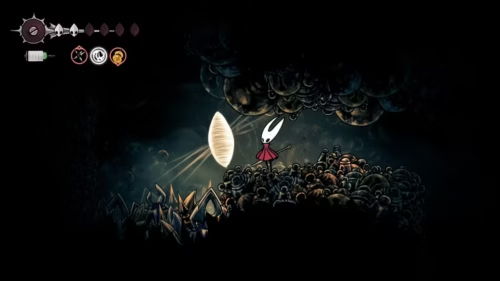
In life, we rush to patch the torn places. The instant gratitude quick fix. But Hornet teaches us that mending is a craft. It takes patience, focus, and practice to mend what’s been torn.
It’s like popping a pimple. Everyone wants to pop the pimple. Not just because it looks bad, but because it’s grossly satisfying. I GET IT. But that’s how scars form. By taking the time to put on a pimple patch, or wash your face and wait it out, or even some home remedy, we mend. We gain the courage to go out into public with a pimple!!! Oh the horror. A blemish on the resume of perfection.
The act of healing in itself is a kind of beauty. The repaired parts come back stronger, just like how muscles build. (Except when it comes to ankles. Protect those things.) And that’s why stretching and being flexible is so important.
But it’s not just the physical repairs. It’s the emotional and mental threads we spin as well. Every apology we give, compromise we make, mistake we forgive, and boundary we set is a thread that we spin when healing.

So the next time you get a pimple… ask a stranger to put a patch on it for you. Congrats. You’re now emotionally, mentally, and physically stronger. Oh also prettier.


